- Workplace Statistics
- Time Management Statistics
- Employee Wellness Statistics
- Employment Discrimination Statistics
- Employee Recognition Statistics
- Employee Referral Statistics
- Workplace Violence Statistics
- Gamification Statistics
- Employee Feedback Statistics
- Agile Statistics
- Productivity Statistics
- Meeting Statistics
- Cell Phones At Work Statistics
- Social Media At Work Statistics
- Workplace Injury Statistics
- Workplace Stress Statistics
- Leadership Statistics
- Workplace Collaboration Statistics
- Job Satisfaction Statistics
- Paid Holiday Statistics
- Communication In The Workplace Statistics
- Wasting Time At Work Statistics
- 4-day Workweek Statistics
35+ Compelling Workplace Collaboration Statistics [2026]: The Importance Of Teamwork
Workplace collaboration research summary. In 2026, workplace collaboration remains a vital skill sought after by employers and hiring managers across various industries in the United States. In this article, we delve into the latest insights and statistics surrounding online teamwork and collaboration:
-
More than 60% of workers in the United States report that their jobs rely heavily on collaboration.
-
Approximately 80% of employees consider teamwork and collaboration to be very important.
-
68% of employers utilize online collaboration tools and social media to communicate with their teams.
-
90% of employees in leadership roles attribute lack of collaboration as a primary cause of workplace failures.
-
Organizations that foster collaboration and communication have been associated with reducing employee turnover rates by 50%.
-
On average, employees report being 20% more satisfied with their jobs when they actively engage in collaboration.
-
Over the past two decades, workplace collaboration has surged by at least 60%.
For deeper insights, we have categorized the data as follows:
Benefits | Remote Work | Trends | Issues
General workplace collaboration and teamwork statistics
Collaboration is essential in any workplace, enabling employees to work effectively in teams. Here are some insights into how workplace collaboration influences teamwork:
-
Employees who collaborate and have access to digital tools report being up to 20% more satisfied with their job and workplace culture.
Research consistently shows that employees engaged in collaboration tend to be happier than those who are not. Moreover, having necessary resources enhances the efficiency of collaboration.
-
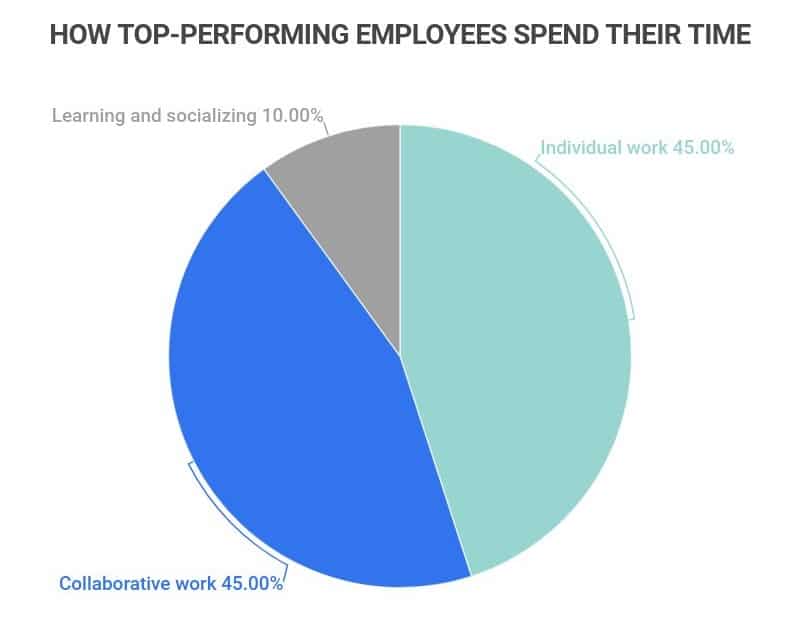
Top performers allocate 40% of their time to individual work, 40% to collaborative efforts, and 20% to learning and socializing.
Top-performing employees at leading U.S. companies spend substantial time on both individual and collaborative tasks, fostering a well-rounded work experience.
-
Individuals in collaborative environments are over 60% more effective at task completion than their independent counterparts.
Research indicates that collaborative work settings lead to superior performance outcomes. Collaborative employees are significantly more likely to adhere to their tasks compared to those working solo.
Furthermore, individuals engaged in workplace collaboration report heightened engagement and lower fatigue levels.
-
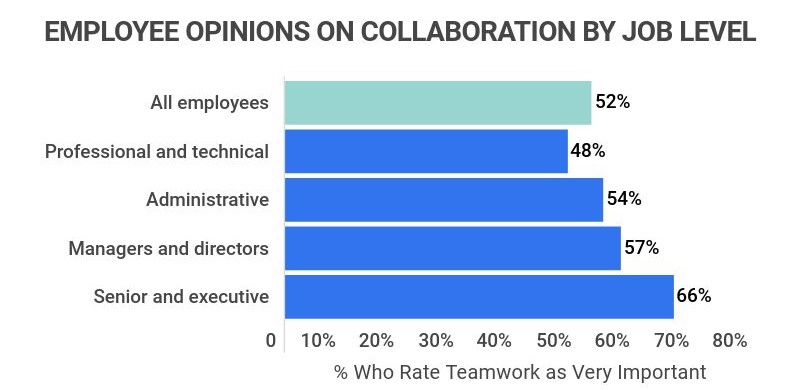
58% of U.S. employees regard teamwork as critical.
A significant number of American workers view collaboration as a cornerstone of career success. This sentiment is echoed across various roles, with 68% of executives emphasizing the importance of in-person collaboration, according to a recent survey by Gensler.
-
Many employees feel that collaboration is lacking at their organization.
Only 12% of surveyed employees believe that their workplace has effective collaboration tools in place, while 40% consider their company’s methods to be somewhat effective, per Deloitte’s findings.
-
38% of employees express that collaboration amongst peers is insufficient.
A global survey on workplace dynamics revealed that a significant portion of employees feel their colleagues do not collaborate enough. Moreover, only 30% of individuals reported feeling confident in their workplace communication abilities.
-
78% of employees view workplace collaboration as “very important.”
Three out of four employees, particularly Millennials who comprise a substantial part of the workforce, place a high value on teamwork and collaboration.
Benefits of collaboration statistics
Workplace collaboration yields numerous benefits, from enhanced morale to improved financial outcomes. Here are key benefits associated with effective collaboration:
-
Collaboration on tasks and idea-sharing equates to a financial value of $1,800 per employee annually, with quality improvements valued at $2,700 per employee each year.
A study by Deloitte highlights how workplace collaboration can translate into significant savings for organizations.
-
Teamwork and collaboration contribute to a 30% increase in company sales.
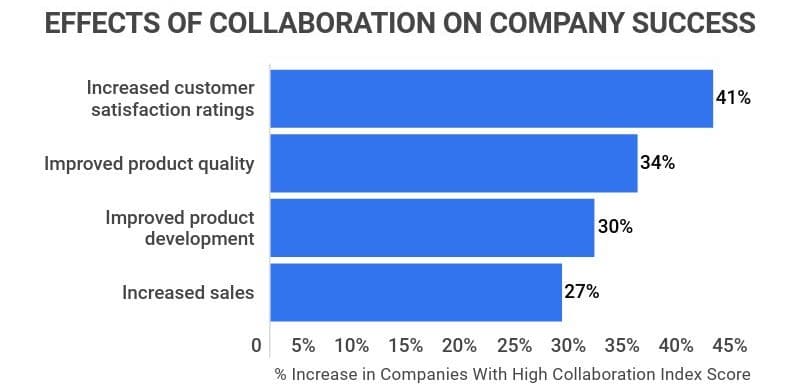
Research indicates that enhanced collaboration can boost sales by 30% and elevate customer satisfaction ratings by 45%, according to Frost & Sullivan. The same study noted a 35% improvement in product quality and a 32% increase in product development efficiency.
-
Employees at collaborative companies are 25% more likely to feel that their employer cares about their morale.
Effective collaboration positively influences employee morale and loyalty. Those in collaborative environments are more inclined to perceive their employer as invested in their well-being.
-
Organizations that prioritize collaboration achieve five times better performance outcomes.
Companies fostering collaborative cultures are significantly more likely to be high performers compared to those with fewer collaboration initiatives.
-
Collaboration helps mitigate burnout and reduce work-related stress.
With 76% of employees experiencing stress at work, studies indicate that team dynamics are linked to a substantial portion of workplace stress. Improved collaboration and communication can significantly enhance team dynamics, thereby reducing stress and burnout rates.
-
Successful workplace collaboration boosts innovation by 35%.
Organizations that embrace collaboration are 35% more innovative and 40% more productive than those that do not, as reported by Frost & Sullivan.
Online collaboration statistics
Remote work presents unique challenges for collaboration, but it remains feasible. Here are vital statistics about online collaboration:
-
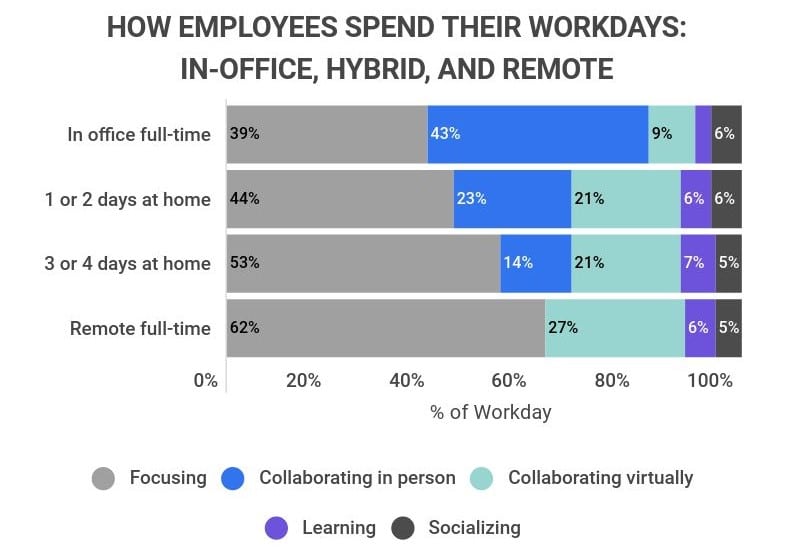
Full-time remote workers spend 50% less time collaborating compared to their in-office counterparts.
This decline in collaboration among remote employees is largely attributed to the evolving work environment as organizations adapt to flexible work arrangements.
-
Remote employees primarily focus on individual tasks rather than collaborating.
Research shows that remote workers devote 65% of their time to focusing, 25% to collaboration, 5% to learning, and 5% to socializing.
-
Approximately 50% of employees believe that online collaboration via social networks enhances workplace productivity.
When segmented by generation, 45% of Boomers, 48% of Gen X, and 55% of Millennials assert that collaboration through social networks boosts productivity.
-
While online collaboration can enhance productivity, it may also create distractions.
Research indicates that 43% of distractions stem from personal conversations, and 38% arise from incoming requests disrupting current tasks.
-
Nearly 95% of organizations utilize online collaboration tools for internal communication.
Among these tools, 35% of companies prefer Microsoft Teams, 28% opt for Google Chat, 20% favor Microsoft Skype for Business, 17% choose Cisco WebEx Teams, and 15% utilize Zoom.
Preferred online collaboration tools
Digital Collaboration Tool Percentage of Companies Microsoft Teams 35% Google Chat 28% Microsoft Skype for Business 20% Cisco WebEx Teams 17% Zoom 15% -
In 2023, 52% of employees reported increased usage of video conferencing tools compared to previous years.
This trend illustrates a growing reliance on video collaboration among employees. Furthermore, 30% of respondents stated that companies utilizing video conferencing are perceived as more innovative.
-
35% of employees advocate for stricter guidelines regarding the use of online collaboration tools.
A significant portion of employees believes that enhanced rules surrounding collaboration app usage could improve work-life balance, with 45% supporting stricter guidelines to establish clear expectations.

Collaboration in the workplace trends
Collaboration remains a priority, prompting employers and employees to seek innovative ways to enhance teamwork. Here are the latest trends in workplace collaboration:
-
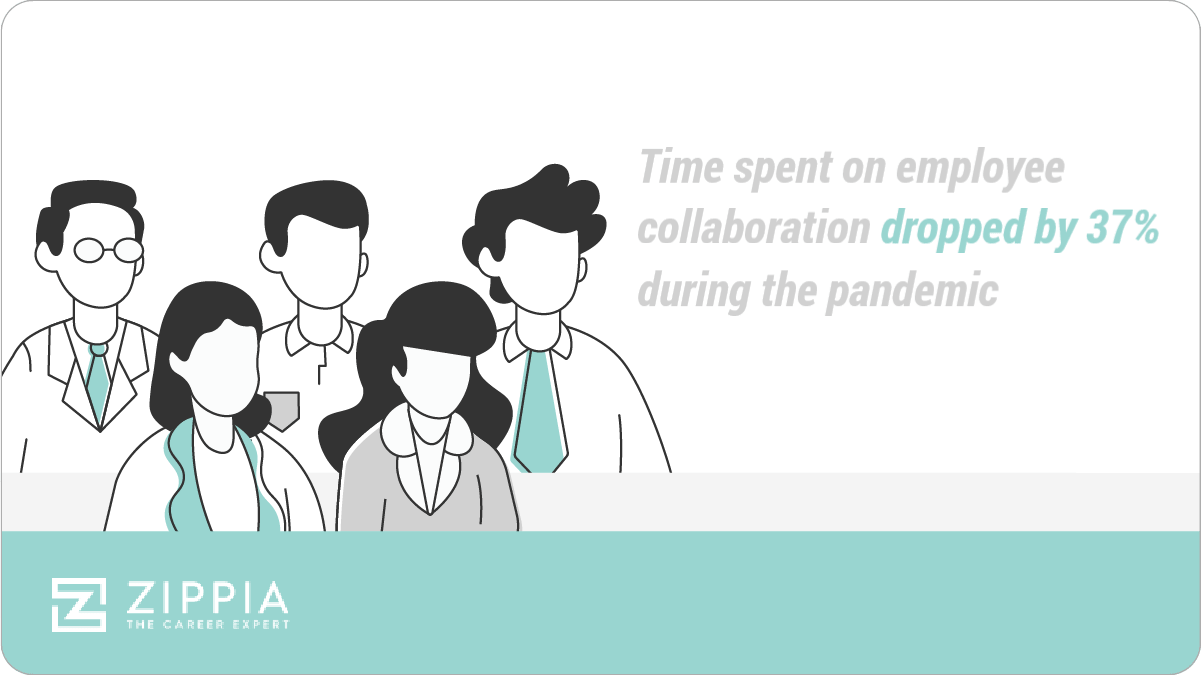
Prior to the pandemic, employees collaborated for 43% of their workweek. Post-pandemic, that number has rebounded to approximately 35%.
Workplace collaboration dynamics have evolved, with a notable shift towards hybrid work models leading to increased collaboration opportunities.
-
The global market for collaboration tools and software is projected to grow at a CAGR of 10.5% from 2023 to 2031.
This growth is anticipated to elevate the market value to $65 billion by 2031, substantially increasing from its previous valuation.
-
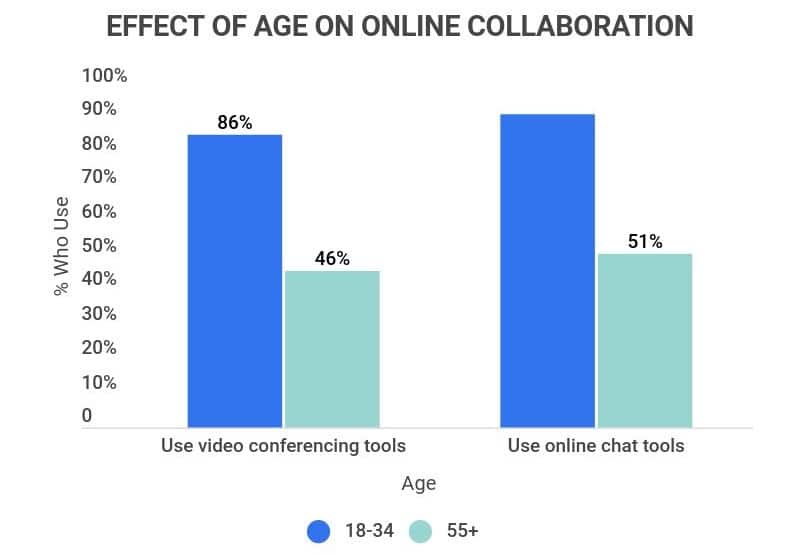
Younger generations are significantly more inclined to engage in workplace collaboration and utilize online tools.
Employees aged 25 to 34 are 50% more likely to use collaboration tools than their older counterparts, showcasing a generational shift in workplace dynamics.
Furthermore, 95% of employees aged 18 to 34 actively use online chat tools compared to just 55% of employees aged 55 and older.
Collaboration issues in the workplace statistics
While collaboration is crucial, it is not always easily achieved. Many organizations do not nurture collaboration sufficiently, and external pressures can hinder teamwork. Here are some common challenges faced:
-
Many organizations reward individual contributions over team achievements.
Research indicates that a lack of incentives for teamwork is a primary reason for collaboration difficulties. A study of over 1,200 companies highlighted that a shared purpose is critical for productive collaboration.
-
Collaboration tends to decline during economic downturns.
Analysis from the World Values Survey suggests that recessions foster a competitive rather than collaborative work environment, leading to reduced teamwork.
-
Approximately 30% of companies underestimate the value of social networks as collaboration tools.
Despite research indicating the importance of social tools, many organizations fail to leverage them effectively for professional collaboration.
-
Poor communication is a leading cause of workplace stress.
Nearly 40% of employees cite “poor communication” as a major stressor, while 30% highlight ineffective teamwork as another significant stress contributor.
-
Excessive collaboration can lead to unfinished tasks.
With the average employee dedicating 90% of their workweek to communication activities, including emails and meetings, this can detract from completing core responsibilities.
Workplace collaboration statistics FAQ
-
How much does collaboration increase productivity?
Collaboration increases productivity by 25% or more. A comprehensive workplace study by McKinsey specifically examined the effects of enhanced collaboration through improved internal social tools, suggesting that the overall impact of collaboration could exceed a 25% increase in productivity.
-
What percentage of jobs use teamwork?
Over 60% of jobs require teamwork. In fact, 58% of American employees rate workplace collaboration as “very important.” Although fewer entry-level workers feel this way, 48% still deem collaboration essential for their roles.
-
How many people should work in a team?
Optimal team size for success is between 4 to 9 members. Smaller teams can face delays and knowledge gaps, while larger teams may struggle with cohesion and accountability. Research indicates the most productive teams usually consist of about 6 members.
-
How do you measure collaboration in the workplace?
Collaboration can be measured through financial KPIs such as Net Profit, Revenue Growth Rate, and Average Revenue Per User. These metrics help assess a company’s performance relative to its peers and track collaboration success over time.
-
Financial KPIs. This metric aids in measuring and comparing a company’s performance with others in the same industry, including revenue growth and profit margins.
-
Revenue Growth Rate. Tracking revenue changes over time helps evaluate collaboration effectiveness. This growth is usually calculated by comparing annual revenue fluctuations between two time periods.
-
Average Revenue Per User (ARPU). This metric is especially useful for some companies, indicating growth among clients or users when calculated by dividing total revenue by the number of consumers.
-
Final Thoughts
Effective collaboration and communication with colleagues, clients, and supervisors are essential for workplace success. Numerous studies demonstrate that collaboration enhances efficiency, fosters a positive workplace culture, and boosts profitability.
While challenges such as stress and insufficient recognition for team efforts persist, the majority of the U.S. labor force relies on collaboration, considering teamwork fundamental to career success. In fact, many employees attribute workplace failures to a lack of collaborative efforts.
Over the past several decades, workplace collaboration has surged by at least 60%, and the trend shows no signs of abating. As we move forward, online collaboration tools are increasingly becoming vital for effective teamwork. With 68% of employers implementing these tools, leveraging digital communication is likely key to ongoing career success.
References
-
Forbes. “New Study Finds That Collaboration Drives Workplace Performance.” Accessed on 8/8/2021.
-
Fortune. “How Companies Can Reinvigorate Collaboration Post COVID.” Accessed on 8/8/2021.
-
Deloitte. “Digital Collaboration: Delivering Innovation, Productivity, And Happiness.” Accessed on 8/8/2021.
-
Queens University Of Charlotte. “Communicating In The Modern Workplace.” Accessed on 8/8/2021.
-
The Future Organization. “The Impact Of Collaboration On Enterprise Business Performance.” Accessed on 8/8/2021.
-
Harvard Business Review. “To Reduce Burnout On Your Team, Give People A Sense Of Control.” Accessed on 8/8/2021.
-
Statista. “Collaboration Software Market Revenues From 2015 to 2024.” Accessed on 8/8/2021.
-
ZDNet. “Employees Crave Stricter Rules Around Collaboration App Usage.” Accessed on 8/8/2021.
-
TechRadar. “Generational Differences In Collaboration At Work.” Accessed on 8/8/2021.
-
Globe Newswire. “Lifesize 2019 Impact Of Video Conferencing Report: More Collaborative Workplace Cultures Have Led To Spike In Video Communication.” Accessed on 8/8/2021.
-
Wrike. “Wrike Survey Reveals Communication And Collaboration Challenges Are Leading Sources Of Stress At Work.” Accessed on 8/8/2021.
-
Wharton University Of Pennsylvania. “Too Much Togetherness? The Downside Of Workplace Collaboration.” Accessed on 8/8/2021.
-
Gensler. “U.S. Workplace Survey Summer/Fall 2020” Accessed on 1/26/2022.
-
Grand View Research. “Team Collaboration Software Market Size Report, 2020” Accessed on 2/16/2023.
- Workplace Statistics
- Time Management Statistics
- Employee Wellness Statistics
- Employment Discrimination Statistics
- Employee Recognition Statistics
- Employee Referral Statistics
- Workplace Violence Statistics
- Gamification Statistics
- Employee Feedback Statistics
- Agile Statistics
- Productivity Statistics
- Meeting Statistics
- Cell Phones At Work Statistics
- Social Media At Work Statistics
- Workplace Injury Statistics
- Workplace Stress Statistics
- Leadership Statistics
- Workplace Collaboration Statistics
- Job Satisfaction Statistics
- Paid Holiday Statistics
- Communication In The Workplace Statistics
- Wasting Time At Work Statistics
- 4-day Workweek Statistics

Author

Elsie is an experienced writer, reporter, and content creator. As a leader in her field, Elsie is best known for her work as a Reporter for The Southampton Press, but she can also be credited with contributions to Long Island Pulse Magazine and Hamptons Online. She holds a Bachelor of Arts degree in journalism from Stony Brook University and currently resides in Franklin, Tennessee.