Research Summary. The workplace landscape has shifted dramatically in recent years, reflecting a persistent trend toward online and hybrid work environments. As organizations adapt to these changes, online workshops, commonly referred to as “webinars,” have surged in popularity. Our comprehensive research reveals the following insights about webinars:
-
At least 83% of U.S. marketers view webinars as an effective tool.
-
The average webinar boasts an attendance rate of approximately 40%, with just 40% of attendees watching the entire event.
-
Since the onset of remote work trends, companies have reported an 87% increase in webinar attendance.
-
The average webinar generates between 500-1,000 leads.
-
The average conversion rate for webinar attendees is 55%.
-
As of 2023, the global webinar market size is estimated to exceed $1.57 billion.
For further analysis, we have categorized the data into the following sections:
Effectiveness | Benefits | Experience | Registration | Optimization

-
Webinar Frequency Statistics
The rise of remote work has made webinars more accessible and frequent than ever. Consequently, this trend has led companies, marketers, and professionals to acknowledge their value. Our research indicates that:
-
58% of B2B marketers utilize webinars for content marketing.
While an impressive 83% acknowledge the effectiveness of webinars, many marketers find it challenging to market effectively. Only 41% attend webinars they deem effective, and 85% admit they don’t dedicate enough time to enhance their content marketing strategies.
-
54% of B2B marketers engage with webinars at least once a week.
This number has increased since the shift to remote work, with 67% of marketers now allocating more time to webinars.
-
At least 57% of marketers host 50 or more webinars annually.
Additionally, 29% host at least 100 webinars per year, indicating that this practice has become routine for many marketers. This figure is expected to rise further as remote work continues to be a preferred model, making online methods vital for B2B marketers seeking new clients.
-
Webinar Effectiveness Statistics
It is clear that no marketing professional would invest in webinars if they were not effective. For lead generation, acquiring new clients, and driving purchases, webinars prove to be a valuable choice for both B2B and B2C marketers. Here are the key statistics:
-
2% to 5% of attendees make a purchase immediately after a webinar.
Although these percentages may seem low, they represent just a fraction of attendees who later make purchases or convert into valuable leads. For instance, if 250 people attend your webinar, securing 12 immediate purchases may be considered successful.
-
15% of attendees will eventually purchase the product or service.
This means that if 250 individuals attended a webinar, at least 37 would convert into clients. This conversion rate is significantly higher compared to the 2% for cold calls and 1% for cold emails.
-
Between 20-40% of B2C webinar attendees become qualified leads.
This statistic positions webinars as one of the most effective marketing tactics, surpassing traditional methods like inbound marketing, direct mail, email campaigns, and trade shows.
-
A remarkable 73% of B2B webinar attendees qualify as leads.
This translates to at least 182 leads from a webinar with 250 attendees, underscoring the cost-effectiveness of webinar marketing for B2B professionals.
-
Webinar Benefits Statistics
Webinars offer numerous advantages for marketers, with lead generation, client acquisition, and profitability being paramount. According to our research, here are additional significant benefits of hosting webinars:
-
60% of businesses utilize webinars to foster customer loyalty.
This is accomplished by leveraging webinars to guide customers through the entire lifecycle. Notably, 73% of B2B webinar attendees become qualified leads, enhancing the effectiveness of this approach.
-
38% of marketers report that webinars yield higher-quality lead generation compared to other channels.
Despite the fact that the average costs of webinars are at least 40% higher than direct mail or email marketing, four in ten marketers recognize their superior effectiveness.
-
48% of B2B buyers consider webinars the most valuable content type for decision-making.
This statistic indicates that nearly half of B2B buyers rely on webinars for critical purchasing decisions, making them an invaluable marketing resource.
-
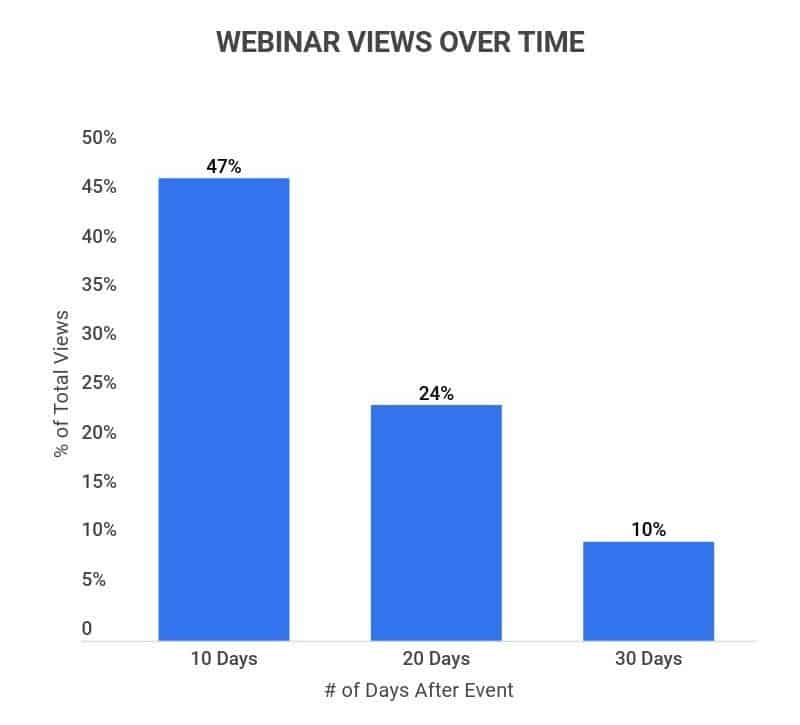
Webinars receive 47% of their views within ten days post-event.
With approximately 24% of views occurring after 20 days and 10% by day 30, making webinars accessible to potential clients after the live event is crucial for maximizing viewership.
-
Webinar Experience Statistics
Attendee satisfaction plays a significant role in the likelihood of purchasing products or becoming clients after a webinar. Here are key insights regarding the average webinar experience:
-
The most popular webinar duration is 60 minutes.
This typically breaks down to five to seven minutes for introductions, 38-45 minutes for presenting content, and a ten to 15-minute Q&A segment.
-
The average viewing time for attendees is 56 minutes.
This suggests that webinars extending beyond 60 minutes may not be well-received. In fact, sessions lasting 90 minutes or more can deter participation.
-
44% of attendees prefer webinars lasting 45 minutes.
Moreover, 41% favor even shorter sessions, around 30 minutes, indicating that only 10% actually desire a full hour-long webinar.
-
92% of attendees appreciate a Q&A segment at the end of a webinar.
This segment typically requires at least ten to 15 minutes to address questions adequately, which can significantly impact the overall duration of a 30-minute webinar.
-
On average, 25% of attendees view webinars on mobile devices.
This further emphasizes the advantage of shorter, mobile-friendly webinars in generating leads.
-
Webinar Registration Statistics
Given the high costs associated with business travel, it’s understandable that companies develop business travel policies. Here are some relevant statistics related to webinar registrations:
-
The average webinar attracts almost 260 registrations.
With an average attendance rate of 40%, this means only 100-110 registrants will typically attend the event.
-
At least 35% of attendees register one to seven days before a webinar.
To reach an attendance goal of 150 people, expect over 50 of those attendees to sign up within the week leading up to the event. Notably, 29% will register on the day of the webinar.
-
Approximately 40% of webinar registrations result in actual attendance.
Hosts should anticipate that registrations will often exceed actual turnout, as less than half of registrants usually attend the webinar.
-
Webinar Optimization Statistics
Given the importance of webinars in client acquisition, optimizing them is crucial for any marketer. Even the timing of the event can significantly impact attendance. Here are some statistics related to webinar optimization:
-
At least 57% of webinar registrations originate from email.
Email remains four times more effective at securing registrations compared to social media, highlighting the value of investment in email marketing strategies.
-
49% of B2B buyers engage with video content before making purchasing decisions.
This reinforces the utility of webinars in providing video content that informs buyers throughout their decision-making process.
-
67% of attendees believe the most critical factor for a successful webinar is an engaging presenter.
This emphasizes the importance of a skilled presenter who not only shares information but also effectively sells a product or service.
-
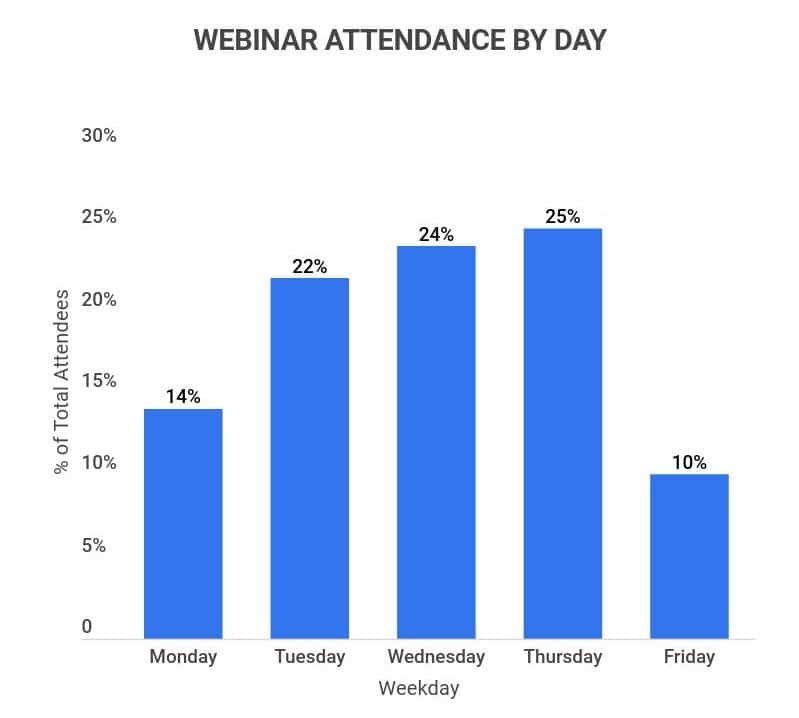
Wednesdays and Thursdays are the optimal days for hosting webinars.
Midweek generally sees higher attendance, while Mondays and Fridays tend to attract fewer participants. On Thursdays, attendance can reach at least 25%, whereas Fridays may see as low as 10%.
Experts suggest this pattern arises from employees adjusting to the workweek on Mondays and being distracted by weekend plans on Fridays.
-
11 AM is the best time to host a webinar, with at least 16% of registrants attending.
In contrast, only 0.1% of registrants attend a 7 AM webinar, and 2.2% participate in a 4 PM session. Popular times also include 1 PM (12.9%) and 2 PM (14.6%).
-
The pharmaceutical industry experiences the highest webinar participation rate at 63%.
Other sectors where webinars thrive include SaaS, consulting, education, and financial services, while advertising has the lowest participation rate at just 33%.
Webinar FAQ
-
What is the average attendance rate for a webinar?
The average attendance rate for webinars is around 40%. Generally, about 40% of those attendees will stay for the entire event. The average webinar receives nearly 260 registrations, leading to about 100-110 attendees and over 40 who remain for the entire session.
-
What is the average conversion rate for a webinar?
The average conversion rate for webinar attendees is 55%. For lead generation, 73% of B2B webinar attendees become qualified leads, while 20-40% of B2C attendees convert into leads.
-
Are webinars effective in 2026?
Yes, webinars remain effective in 2026. Webinars have consistently proven to be more cost-effective than other common advertising methods, such as inbound marketing, direct mail, email campaigns, and trade shows.
-
How is webinar performance measured?
Several metrics can effectively gauge webinar performance. Common methods include surveys and audience questions. Additionally, consider these measurement techniques:
-
Lead generation. What percentage of your audience converted to qualified leads?
-
Customer engagement. Did your audience ask questions during the Q&A?
-
Audience retention. Did your audience stay until the end of the webinar?
Each of these factors will provide insight into your webinar’s success, especially when measured collectively.
-
-
What’s the difference between a Zoom meeting and a webinar?
The primary distinction between a Zoom meeting and a webinar is participation. In a Zoom meeting, all attendees actively engage by sharing screens, turning on video and audio, and seeing one another. In contrast, webinars focus on the host and the information presented, with attendees typically in a “view-only” mode. Engagement is primarily limited to the Q&A segment.
Conclusion
Webinars are an increasingly popular and cost-efficient strategy for both B2B and B2C marketing. Overall, 20-40% of B2C attendees convert into qualified leads, while an impressive 73% of B2B attendees do the same. This makes webinars a more cost-effective option compared to inbound marketing, direct mail, email campaigns, and trade shows.
Nonetheless, there are still opportunities for marketers to enhance their webinar strategies. While the average webinar lasts about 60 minutes, 44% of attendees prefer sessions closer to 45 minutes, and 41% would like even shorter formats around 30 minutes. Moreover, 92% of attendees value a Q&A segment at the end, and 67% emphasize the importance of an engaging presenter.
By aligning with these preferences, webinars can generate thousands of leads, reinforcing why 83% of U.S. marketers consider webinars effective.
Sources:
-
KoMarketing. “Report: B2B Marketers Finding Content Success in Virtual Spaces.” Accessed on December 14th, 2021.
-
SEJ. “91% of B2B Professionals Say Webinars Are Their Preferred Type of Content.” Accessed on December 14th, 2021.
-
ON24. “All About Digital Engagement and Webinar Marketing.” Accessed on December 14th, 2021.
-
ConvertKit. “Focus on these metrics to improve your webinar conversions.” Accessed on December 14th, 2021.
-
ReadyTalk. “Why Webinars Produce More Qualified Leads [Infographic].” Accessed on December 14th, 2021.
-
Marketing Charts. “How B2B Marketers Are Using Webinars and Plan to Improve Them.” Accessed on December 14th, 2021.
-
Marketing Charts. “B2B buyers have spoken: here’s what they want from your content marketing.” Accessed on December 14th, 2021.
-
Smart Insights. “Webinar response statistics.” Accessed on December 14th, 2021.
-
BrightEdge. “What is the Best Length for a Webinar?” Accessed on December 15th, 2021.
-
YourTarget. “Everything You Need To Know About Webinars.” Accessed on December 15th, 2021.
-
LinkedIn. “Webinars – what they can do for you.” Accessed on December 15th, 2021.
-
ReadyTalk. “Benchmarking Webinar Best Practices: In-Event [Infographic].” Accessed on December 15th, 2021.
-
GoTo. “Introducing the Big Book of Webinar Stats: We Analyzed 250,000 Webinars to Help You Make Yours Better – GoToWebinar.” Accessed on December 16th, 2021.
-
LiveWebinar. “Best time of day and week to host webinars.” Accessed on December 16th, 2021.
-
GoTo. “7 Webinar Scheduling Secrets to Maximize Registrations – GoToWebinar.” Accessed on December 16th, 2021.

Author

Jack Flynn is a writer for Zippia. In his professional career he’s written over 100 research papers, articles and blog posts. Some of his most popular published works include his writing about economic terms and research into job classifications. Jack received his BS from Hampshire College.