- Business Statistics
- Startup Statistics
- Cloud Adoption Statistics
- Customer Loyalty Statistics
- Nonprofit Statistics
- Affiliate Marketing Statistics
- Cart Abandonment Rate Statistics
- Ridesharing Statistics
- Call Center Statistics
- eLearning statistics
- Customer Service Statistics
- Customer Experience statistics
- Entrepreneur Statistics
- Outsourcing Statistics
- Gross Revenue for Marketing and Advertising
- Sales Statistics
- MBA Statistics
- Average Small Business Revenue + Profit Margin
- How Much Do Employee Benefits Cost?
Cloud Adoption Research Summary. In 2026, cloud computing remains an essential component for businesses across various sectors. From data storage solutions to networking software, cloud technology provides cost-effective and indispensable services. This article showcases the significance of cloud adoption through recent statistics:
-
94% of enterprises utilize cloud services.
-
67% of enterprise infrastructure is now cloud-based.
-
92% of businesses have established or are developing a multi-cloud strategy.
-
The global cloud computing market reached a size of $480.04 billion by 2022.
-
The U.S. public cloud market is projected to grow to $258.10 billion by the end of 2023.
For further analysis, we broke down the data in the following ways:
Usage | Projections | Trends | Benefits | Services
General Cloud Adoption Statistics
Cloud adoption has increased significantly in recent years, driven by its numerous advantages. Before exploring these benefits, here are some essential facts regarding overall cloud adoption:
-
In 2021, 61% of businesses migrated their workloads to the cloud.
This transition was influenced by the evolving nature of work, with many organizations adopting remote work strategies that rely heavily on cloud infrastructure.
-
48% of businesses store their most critical data in the cloud.
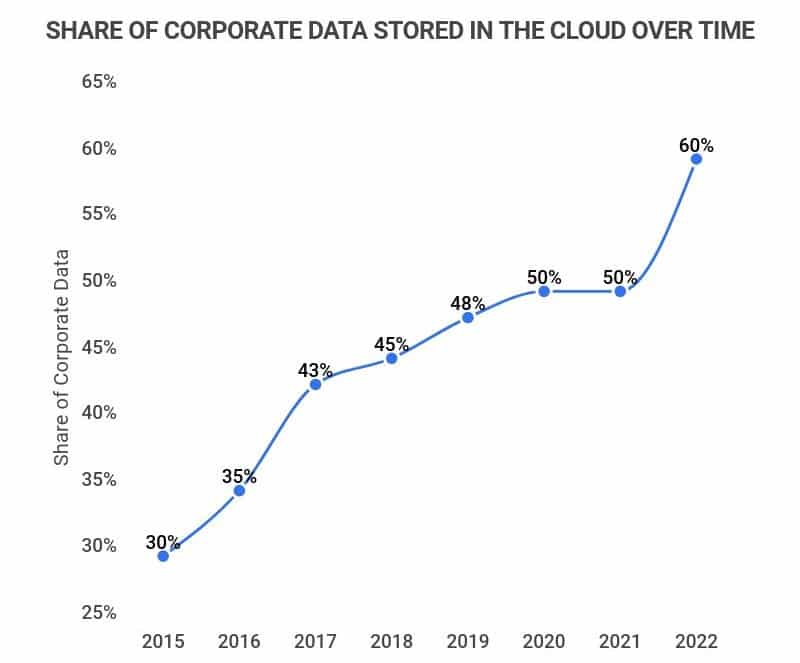
As of 2026, around 60% of all corporate data is stored in the cloud, demonstrating a strong trust in its security and reliability.
-
The global cloud computing market is projected to grow at a CAGR of 16.3% through 2026.
Having reached $445.3 billion in 2021, the market is expected to expand to $947.3 billion by 2026, reflecting robust growth.

Cloud Adoption Statistics by Cloud Usage
The rapid adoption of cloud services by businesses has led to a substantial increase in the number of services utilized. Here are some insights regarding current cloud usage:
-
The average employee utilizes 36 cloud-based services daily.
With numerous collaboration tools available, such as Dropbox, Microsoft Teams, and Google Workspace, it’s not surprising that employees engage with multiple services.
-
The average enterprise employs 1,295 cloud services.
This marks a 26.7% increase from 2016 when enterprises averaged 1,022 cloud services.
-
87% of businesses have adopted a hybrid cloud strategy.
Hybrid cloud solutions combine multiple cloud types to optimize flexibility and cost-effectiveness, making them a preferred choice for 45% of organizations.
Cloud Adoption Projections
The cloud has become a vital tool for enterprises, and as internet use continues to grow, its adoption is set to rise further.
According to our research:
-
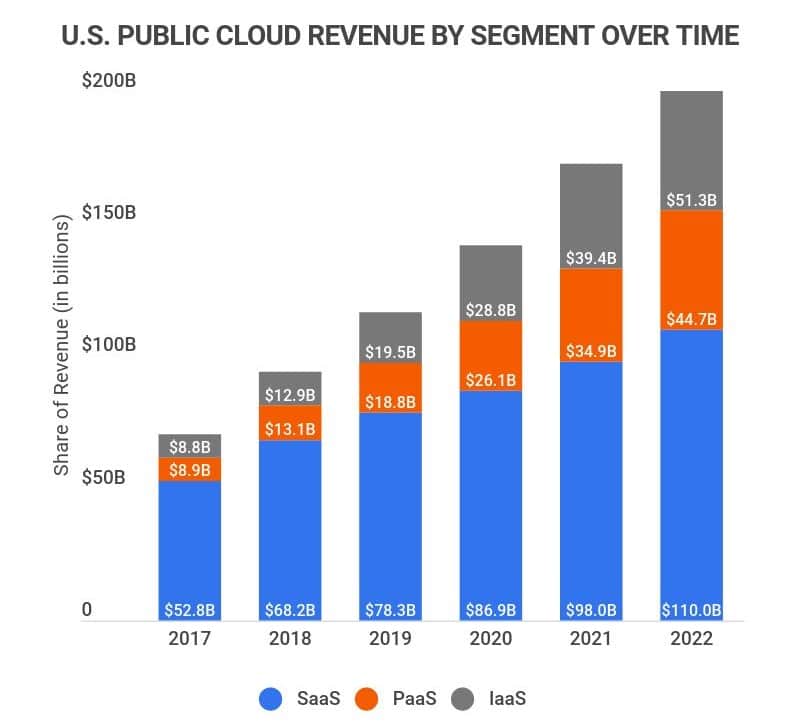
By the end of 2022, U.S. cloud spending exceeded $90 billion (27.8% growth compared to 2021).
-
By 2025, an estimated 175 zettabytes of data will be stored in the cloud, representing a 61% increase from current levels.
-
The cloud computing industry is expected to grow by $287.03 billion between 2020 and 2025.
-
By 2026, 45% of all enterprise IT budgets will be allocated to cloud services.
-
61% of businesses plan to optimize their cloud costs in the coming year.
Cloud Adoption Trends
The growth of cloud adoption over the past decade has been remarkable. Here are some compelling statistics illustrating this trend:
-
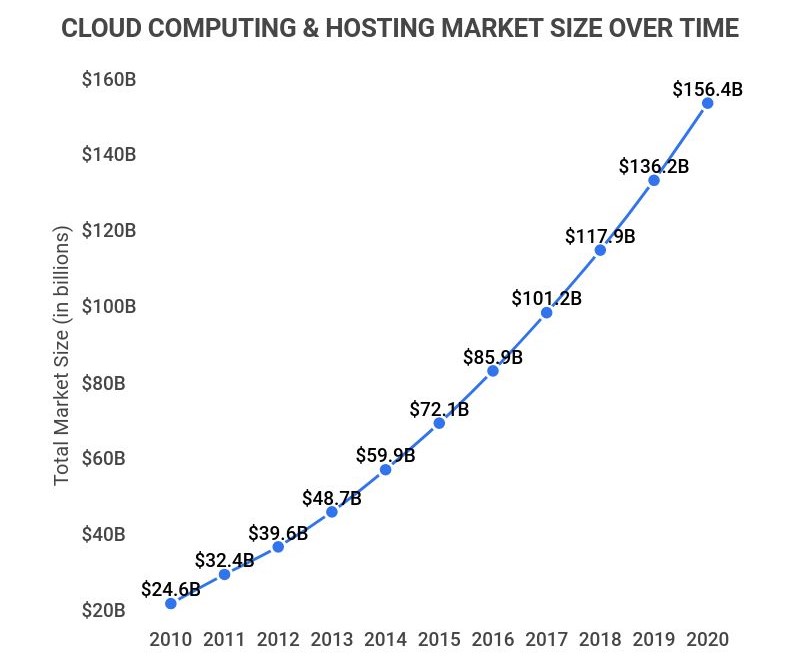
Between 2010 and 2020, the global cloud computing and hosting market grew by 535%.
From a valuation of $24.6 billion in 2010, the market expanded to $156.4 billion by 2020.
-
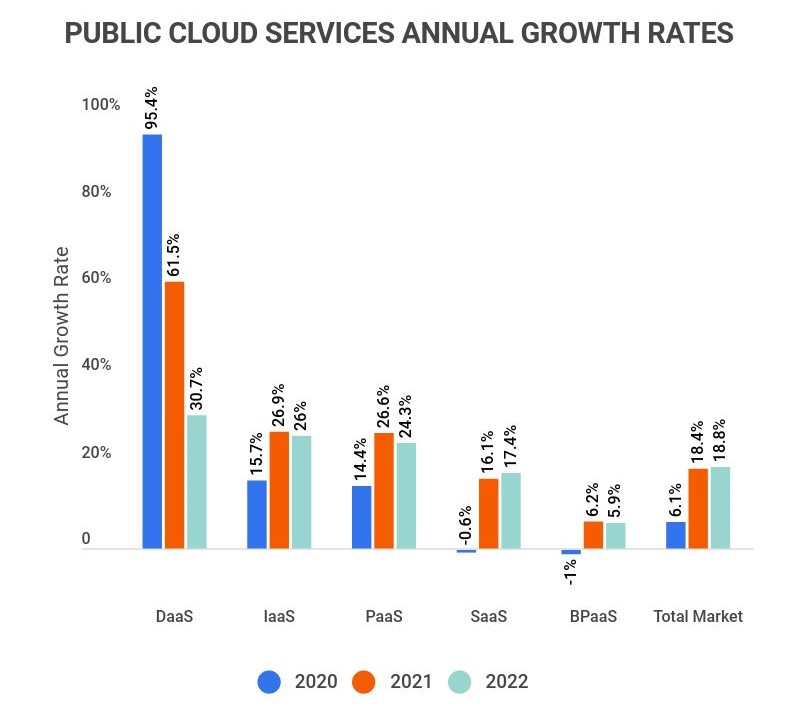
Public cloud services experienced an 18.4% year-over-year growth in 2021.
In contrast, growth was only 6.1% in 2020. Desktop as a Service (DaaS) has been a standout segment, with growth rates of 95.4% in 2020 and 61.5% in 2021.
-
Cloud computing spending surged by 35.3% year-over-year in 2021.
Spending increased from approximately $140 billion in 2020 to $191.7 billion in 2021, indicating continued momentum into 2022.
Cloud Adoption Statistics by Top Benefits of Adoption
Cloud adoption is favored by enterprises due to its significant advantages. Key benefits include:
-
94% of businesses report enhanced online security after adopting cloud solutions.
Cloud technology employs encryption, making it more secure against unauthorized access. Many services allow users to customize their security settings.
-
80% of companies report operational improvements post-cloud adoption.
Companies see benefits within months of transitioning, regardless of their size.
-
82% of small and medium businesses experience cost reductions after adopting cloud technology.
Moreover, 59% report increased productivity among their IT teams, contributing to the 78% adoption rate among small and medium enterprises.
-
93% of businesses cite cloud security as their primary concern.
Despite enhanced security, worries about data leakage remain prevalent, with visibility into file activities being a significant concern.
Cloud Adoption Statistics by Cloud Storage Services
Storage capabilities are a fundamental aspect of cloud services. Here are some notable statistics about cloud storage:
-
60% of all corporate data is now stored in the cloud.
This figure has doubled from 30% in 2015, reflecting growing trust in cloud storage solutions.
-
Four companies dominate 67% of the global cloud infrastructure market.
Amazon Web Services leads with a 32% market share, followed by Azure (20%), Google Cloud (9%), and Alibaba Cloud (6%).
Cloud Adoption Statistics FAQ
-
What percentage of companies use cloud services?
94% of companies utilize cloud services in 2023. This significant figure reflects a major shift in 2020 when 61% of businesses migrated their workloads to the cloud. Adoption rates continue to rise.
-
What percentage of workloads are in the cloud?
Approximately 41% of enterprise workloads are now in the cloud. This percentage has steadily increased, with 33% of enterprises running over 50% of their workloads in the cloud as of 2021.
The benefits of cloud workloads include enhanced elasticity, cost efficiency, increased collaboration, business agility, disaster recovery, and competitive advantages.
-
How fast is the cloud computing market growing?
The global cloud computing market is projected to grow at a CAGR of 16.3% through 2026. This translates to an increase from $445.3 billion in 2021 to $947.3 billion by 2026.
Public cloud services have also demonstrated considerable growth, with an 18.4% increase year-over-year in 2021.
-
How many cloud users are there?
There are over 3.6 billion cloud users worldwide. This accounts for 47% of the global population, highlighting the pervasive use of cloud technology.
-
Who is the market leader in cloud computing?
Amazon leads the cloud computing market. Amazon Web Services holds a 32% market share, followed by Azure (20%), Google Cloud (9%), and Alibaba Cloud (6%). These four companies collectively represent 67% of the market share.
-
What is mitigation in cloud computing?
Mitigation refers to minimizing risks. Companies often implement a zero-trust security framework to safeguard against unauthorized access, requiring regular authentication and authorization for all users.
Conclusion
The cloud has evolved into a vital tool for organizations and individuals alike. As of 2026, 94% of enterprises utilize cloud services, a significant increase driven by the need for agile and secure business operations.
Businesses recognize the many advantages of cloud adoption, including cost savings and improved data security, with 80% reporting operational enhancements after transitioning to the cloud.
With the global cloud computing market expected to reach $947.3 billion by 2026, the momentum of cloud adoption is clear. As organizations continue to integrate cloud solutions, the landscape of business technology will transform further.
Sources:
-
Faction. “Multi-Cloud Trends: The Latest Trends of 2022.” Accessed on June 23, 2026.
-
MarketsandMarkets. “Cloud Computing Market.” Accessed on June 23, 2026.
-
Techiexpert. “The Rise of Cloud Migration and Management Services.” Accessed on June 23, 2026.
-
Statista. “Share of corporate data stored in the cloud in organizations worldwide from 2015 to 2022.” Accessed on June 23, 2026.
-
Statista. “Public Cloud.” Accessed on June 23, 2026.
-
McAfee Enterprise. “12 Must-Know Statistics on Cloud Usage in the Enterprise.” Accessed on June 23, 2026.
-
Chiefmartec. “The average enterprise uses 1,295 cloud services.” Accessed on June 23, 2026.
-
Fierce Telecom. “IDC tips US to lead as cloud infra spending jumps over 20% in 2022.” Accessed on June 23, 2026.
-
HelpNetSecurity. “Cloud computing market to reach $287.03B by 2025.” Accessed on June 23, 2026.
-
Gartner. “Gartner Says Four Trends Are Shaping the Future of Public Cloud.” Accessed on June 23, 2026.
-
Statista. “Size of the cloud computing and hosting market worldwide from 2010 to 2020 (in billion U.S. dollars).” Accessed on June 23, 2026.
-
Statista. “Public cloud services annual growth rate worldwide from 2020 to 2022, by segment.” Accessed on June 23, 2026.
-
ZDNet. “Cloud computing just hit another huge milestone.” Accessed on June 23, 2026.
-
Elearning. “10 Amazing Facts About Cloud Computing Infographic.” Accessed on June 23, 2026.
-
Ntiva. “Why Companies Are Moving To The Cloud.” Accessed on June 23, 2026.
-
HelpNetSecurity. “93% of businesses are worried about public cloud security.” Accessed on June 23, 2026.
-
Statista. “Share of corporate data stored in the cloud in organizations worldwide from 2015 to 2022.” Accessed on June 23, 2026.
-
PC. “4 Companies Control 67% of the World’s Cloud Infrastructure.” Accessed on June 23, 2026.
- Business Statistics
- Startup Statistics
- Cloud Adoption Statistics
- Customer Loyalty Statistics
- Nonprofit Statistics
- Affiliate Marketing Statistics
- Cart Abandonment Rate Statistics
- Ridesharing Statistics
- Call Center Statistics
- eLearning statistics
- Customer Service Statistics
- Customer Experience statistics
- Entrepreneur Statistics
- Outsourcing Statistics
- Gross Revenue for Marketing and Advertising
- Sales Statistics
- MBA Statistics
- Average Small Business Revenue + Profit Margin
- How Much Do Employee Benefits Cost?

Author

Jack Flynn is a writer for Zippia. In his professional career he’s written over 100 research papers, articles and blog posts. Some of his most popular published works include his writing about economic terms and research into job classifications. Jack received his BS from Hampshire College.